PDF sewing patterns for women’s flowing trousers
Showing all 7 results
-

Aïs trousers and shorts, sizes 32 to 52
-

Orsi trousers or shorts
-

PDF pattern for the Rosie pyjama top and trousers set
-

PDF pattern for women’s trousers, sizes 32 to 60
-
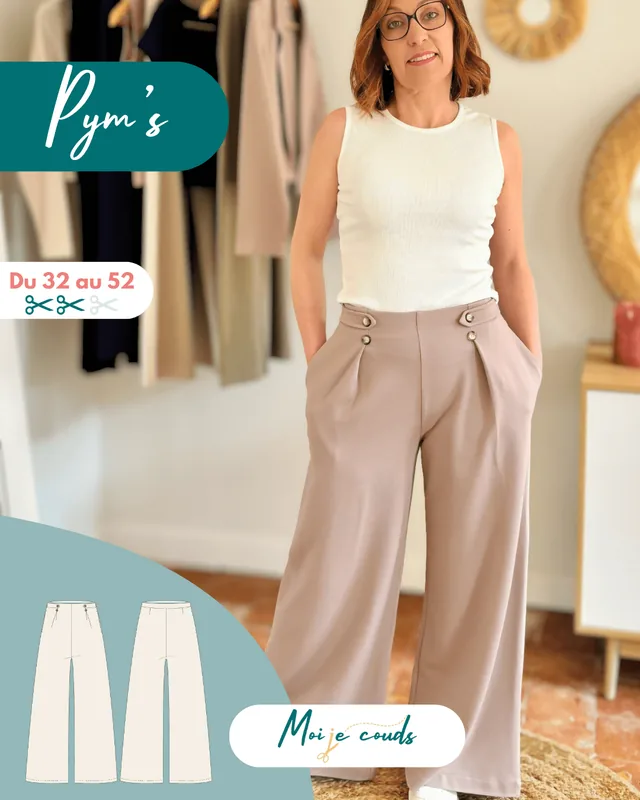
Pym’s trousers – women’s PDF pattern, sizes 32 to 52
-

Rigotte trousers – women’s PDF pattern, sizes 34 to 54
-

Trousers – Deauville shorts – sizes 34 to 48
PDF patterns for women’s flowing trousers: choosing the right style based on cut and fabric
The success or failure of a flowing pair of trousers comes down to two things: the cut of the pattern and the choice of fabric. These two factors are interlinked. A pattern designed for 120 g/m² viscose will not give the same result in 160 g/m² linen, and it’s not just a question of aesthetics — it’s a question of drape, structure and actual comfort when worn. This collection of PDF patterns for women’s flowing trousers covers the main styles, with instructions detailed enough to help you make these choices before cutting.
Wide-leg, palazzo and straight-leg flowing styles: what sets each silhouette apart
The women’s wide, flowing trouser pattern in the palazzo style is recognisable by its fitted hip yoke followed by a leg that flares out from the hips. The width at the hem often reaches 60 to 75 cm per leg depending on the size, which requires fabric with sufficient width. Remember to check the width of your fabric before purchasing: a viscose jersey with a width of 140 cm requires more precise placement than a crepe with a width of 150 cm.
The high-waisted flowing trousers PDF pattern follows a different approach: the waistband sits 4 to 7 cm above the navel, which visually lengthens the leg but requires precise management of darts or gathers at the waist to avoid a puffed-out effect. Patterns with darts at the front are more technically demanding but produce a neater finish than styles that are entirely gathered on elastic.
The straight, flowing cut, which falls somewhere in between, is often the most versatile. Worn in summer with 100 g/m² EcoVero viscose, they make for perfect beach trousers. In 130 g/m² polyester crepe, they transition effortlessly to the office. This is generally the recommended cut for a first project.
Which fabrics for a successful flowing drape: viscose, linen, crepe or lightweight cotton
Viscose remains the go-to fabric for women’s summer flowing trousers patterns. Supple, with a natural drape that falls smoothly without stiffness, it is easy to cut provided you work on a stable surface and secure the fabric with fine pins or dressmaker’s weights. Its only drawback: it tends to slip whilst cutting. A simple tip is to place the pattern on the folded fabric, right sides together, and cut through both layers at once.
Lightweight linen (110 to 140 g/m²) is ideal for straight-leg or palazzo styles for the summer. It doesn’t take to tight gathers as well as viscose — gathering it too much makes it look bulky. Opt for linen for styles with few gathers and plenty of volume in the leg.
Viscose crepe or polyester crepe, weighing around 120 to 140 g/m², offers the best balance between drape and ease of working. It doesn’t slip, it cuts cleanly, and it drapes evenly. This is the fabric I always recommend for beginners working with this type of pattern.
Reading a PDF pattern for flowing trousers: what to check before printing
PDF patterns are available in two print formats: A4 with assembly (pages to be glued together) or A0, to be printed at a copy shop for 2 to 5 euros for a quick print. For wide-leg trousers with several nested sizes, the A0 format actually saves 45 minutes of assembly time and reduces errors when gluing the pieces together. If you’re printing on A4, always check the test square (10 x 10 cm or 5 x 5 cm depending on the publisher) before assembling anything.
Also check for details of the seam allowances. Some patterns include them (often 1 cm), others do not. Overlooking this will shift all the seams and may make the garment 2 to 4 cm too narrow, depending on the design. This information is usually found on the first page or in the contents section of the instructions.
Putting the outfit together: pairing trousers with a hand-sewn blouse
High-waisted, flowing trousers naturally call for a cropped or mid-length top that doesn’t cover the waistband. A slightly sheer blouse in cotton voile or georgette, tucked in or tied at the waist, balances out the volume of the wide leg. To take the creation of this complete look a step further, the collection of PDF patterns for flowing women’s blouses offers designs created specifically for this type of combination.
If you’re looking to explore other wardrobe essentials, the collections of women’s skirts, women’s jumpsuits and women’s dresses naturally complement the focus on lightweight fabrics and loose-fitting cuts. Seamstresses who regularly work with flowing fabrics will find the same technical challenges from one garment to the next — so it’s best to master them on a pair of trousers, which are more forgiving of minor imperfections than a structured dress.
Frequently asked questions about PDF patterns for flowing trousers
What is the difference between palazzo trousers and wide-leg flowing trousers?
Palazzo trousers refer to a style that is very flared from the hip, with a leg width of over 60 cm at the bottom. Wide-leg flowing trousers can be straight or slightly flared. The difference lies in the volume at the bottom of the leg, not in the fabric used.
Is a flowing trousers pattern suitable for beginners?
Patterns with an elasticated waistband and no darts are suitable for beginners. Allow 2 to 3 hours for your first attempt. High-waisted patterns with front darts require an intermediate level, especially if you need to adjust the waist.
Can you use standard cotton for a flowing trouser pattern?
Standard cotton (160 g/m² and above) will not drape in the same way as viscose or crepe. If you want to stick with cotton, choose a cotton voile, batiste or crepon: their lower weight (80 to 120 g/m²) replicates the drape expected for these patterns.
How do you choose your size for a high-waisted, flowing trouser pattern?
Take your actual waist and hip measurements, then refer to the pattern’s size chart, using the higher of the two measurements. For high-waisted trousers, the hip measurement is often the determining factor. There’s no need to go up a size for ease: this is already built into the pattern.