Women’s coat PDF patterns
Showing all 21 results
-

Amande: the bomber jacket
-

Arybelle jacket, sizes 32 to 60
-

Bogota jacket
-
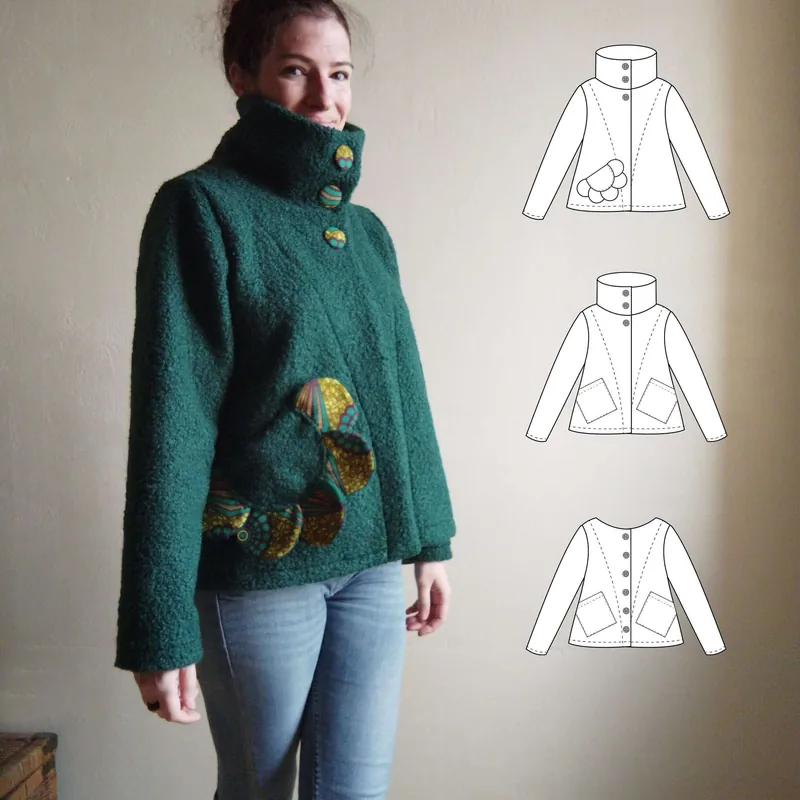
Camur jacket, sizes 32 to 60
-

Cérès shepherd’s cardigan
-

Coat – XS to L – Fluffy Love
-

Cosmos jacket
-

Framboise – the perfecto
-

Goya shepherd’s jacket – women’s
-

Jade coat and jacket
-

Kezia – Unisex sleeveless puffer jacket for adults, sizes XS to XXXL
-

Kezia Duo Puffer Jacket PDF Pattern for the whole family
-

La Captivante Cape – one size fits all
-

Milda coat in 15 sizes from 30 to 58
-

Orséis blazer, sizes 36 to 50
-

PDF pattern for Macadamia hooded zip-up jumper/jacket
-

PDF pattern for the ‘Avocat’ coat for the whole family
-

Phoenix bomber jackets
-

Quetsche – the windbreaker with a front pocket
-

Shawl with pockets – Angélique
-

Women’s cardigan, sizes 34 to 56, 4 body types – Jasmin
PDF patterns for women’s coats: choosing the right style before cutting the fabric
A coat is one of the most time-consuming and material-intensive sewing projects. Depending on the style, you’ll need between 15 and 25 pattern pieces, 2 to 4 metres of main fabric, and often just as much lining. Before choosing a PDF pattern for a women’s coat, the question of skill level is therefore key: not because a beginner can’t manage it, but because a poor choice at the outset can turn an exciting project into a nightmare that gets stuck at the buttonhole stage.
Which women’s coat pattern to choose based on your sewing level
Patterns for women’s coats for beginners share a common feature: they avoid pieces that require millimetre-precise cutting. A straight, unlined coat made from boiled wool, with a round neckline and straight seams, is achievable after 6 to 8 months’ practice. Boiled wool doesn’t fray when cut, which means you don’t need an overlocker.
Intermediate-level patterns introduce lining, a tailored collar or shawl collar, and classic set-in sleeves (as opposed to raglan sleeves, whose slanted armhole is much more forgiving). At this stage, interfacing becomes essential: it provides structure to facings, collars and buttonholes, and the quality of the final result depends directly on it.
The patterns for women’s coats for experienced seamstresses incorporate piped pockets (two layers to be cut with 2 mm precision), hand-finished tailored buttonholes, and linings with box pleats that allow the coat to drape naturally without restricting movement. A well-constructed pea coat, with its six buttons and double-breasted lapels, falls into this category.
Fabrics for coat sewing patterns: what really makes a difference to the result
The choice of fabric determines both the construction and the appearance. Here’s what you need to know about the main fabrics used for sewing coat patterns:
- Boiled wool (400 to 500 g/m²): clean edges without an overlocker, ideal without a lining, holds its shape without heavy interfacing. Suitable for straight and cocoon-style coats.
- Wool cloth (500 to 700 g/m²): requires a lining and structuring interfacing, but gives an unrivalled drape to fitted coats or pea coats. Allow for 10 to 15 per cent shrinkage in the wash before cutting.
- Corduroy (8 to 14-rib): a mid-season option, machine-washable and lighter than wool. Pay attention to the direction of the pile: cut all pieces in the same direction to avoid an uneven finish.
- Quilted fabric: warm without being excessively thick, but the seams hold three times as much fabric as a flat fabric. Opt for patterns with few pieces and open seam allowances.
A4, A0 and projector-sized PDF formats: what you need to know before printing
An A4-format PDF pattern for a women’s coat can consist of 35 to 50 sheets to be joined end-to-end. It’s doable, but it takes between 1½ and 2½ hours depending on the precision of the assembly marks. Before buying, check that the pattern includes a test square (5 × 5 cm) to be printed without scaling: if this square is not accurate, all your measurements will be incorrect.
The A0 format can be printed as a single sheet at a print shop (expect to pay €2 to €5 per sheet) and eliminates the need for piecing. For a coat, this is often the most time-efficient option. The projector format, on the other hand, projects the pattern directly onto your fabric or cutting paper via a ceiling-mounted video projector. This system has been growing rapidly within the French sewing community since 2022: some designers now offer all three formats in the same file.
Designers of women’s coat patterns featured here
This collection brings together French pattern houses, several of which have developed distinctive coat designs: Atelier Adriette for its structured constructions, Instinct Couture for its detailed instructions tailored to seamstresses returning to the craft after a long break, Vestiaire Éponyme for contemporary silhouettes with deep armholes. Kandix and Lab Zéro offer extended size ranges, an increasingly important factor when choosing a pattern.
Before buying, always check the size chart provided by the designer, not the size indicated. In dressmaking, a size 42 from one designer may correspond to a 44 or a 40 from another, depending on whether the measurements include ease.
Pairing your handmade coat with other items in your wardrobe
A hand-sewn coat works all the better when it forms part of a cohesive outfit. patterns for women’s trousers allow you to adjust the length of the coat to suit the leg: a mid-thigh-length coat worn with high-waisted straight-leg trousers creates a very different silhouette to a long coat worn with flared trousers. When it comes to women’s jackets, some seamstresses first make a lined jacket as a test piece: the same construction logic, less fabric, and half the time.
For cool silhouettes that need dressing from head to toe, women’s sweatshirts and women’s dresses provide a solid base under a coat worn open. Women’s blouses, which are more structured, can be worn under a fitted coat without creating unwanted bulk at the shoulders.
What is the difference between a straight-cut coat pattern and an oversized coat pattern?
A straight-cut coat is cut with 8 to 12 cm of ease around the bust. An oversized coat allows for 18 to 25 cm or more, with dropped shoulders and a deeper armhole. In practical terms, an oversized coat is more forgiving of sewing imperfections, but requires more fabric (generally an extra 0.5 to 1 m).
Can you sew a women’s coat without an overlocker?
Yes, provided two conditions are met. Either you use boiled wool or felt, which do not fray at the edges. Or your sewing machine has a tight zigzag stitch or an overlock stitch, which can replace the overlocker for tightly woven, non-looped fabrics such as wool flannel.
How do I choose between A4 and A0 sizes for a PDF coat pattern?
If your coat has more than 20 pattern pieces, the A0 size (€3 to €5 at a print shop) will easily save you two hours of piecing together the pattern. For a simple design with 8 to 12 pieces, A4 is still quick to glue together. Always check that the pattern includes a 5 × 5 cm test square before printing.
Which women’s coat patterns are suitable for plus sizes?
Several designers in the shop offer ranges up to size 54 or 56 with detailed measurement charts. Filter by designer and check their measurement charts before buying: some patterns include built-in ease, whilst others require you to add ease yourself according to your preferred drape.
How many metres of fabric do you need to sew a women’s coat?
Between 2 and 3.5 metres of main fabric, depending on the length and width of the bolt (140 or 150 cm). Add 1.5 to 2.5 metres of lining for a lined coat. A short pea coat requires less (1.8 to 2.2 m), whilst a long parka requires more (3 to 3.5 m). Always check the fabric requirements listed on the product page, which are calculated for your size.
For children’s coats, the construction method is similar but the quantities are roughly halved. For men’s coats, the structured shoulders and the ease in the back width significantly alter the cut.